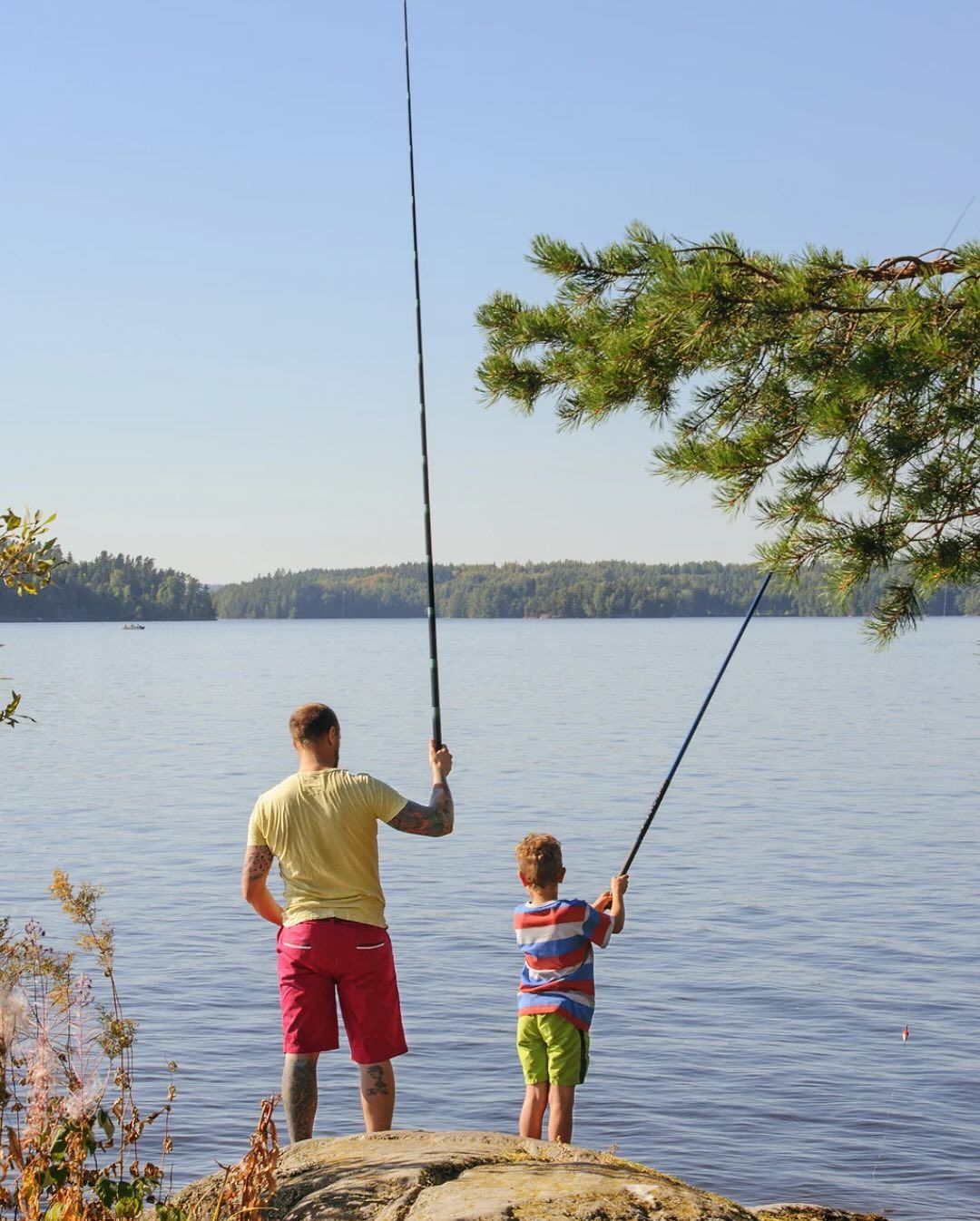
Fishing with kids sounds simple.Bring a small rod, buy some worms, find a pond, and wait for one of those perfect father-and-son moments to happen.
At least that’s the version in your head.

In real life, after reading through a lot of experiences from parents who actually fish with young kids, the day often looks more like this:
someone’s line is tangled,
someone needs another worm,
someone dropped the bobber,
someone is hungry,
and apparently the only person who isn’t fishing is you.
That doesn’t mean fishing with kids is a bad idea.
Quite the opposite.
A lot of parents who survived those early chaotic trips now have teenagers who voluntarily wake up before sunrise to fish with them.
But there are a few things they seem to learn along the way.
1. The First Surprise: You Probably Aren’t Going Fishing
This came up again and again.
Parents imagine:
I’m taking my kid fishing.
What actually happens is:
I have been promoted to unpaid fishing guide.
One father described his day as an endless rotation of tying hooks, adding bobbers, putting worms on hooks, untangling line and taking fish off.
His children all caught bluegill.
He caught nothing.
Another parent’s advice was even more ruthless: don’t even bother bringing your own rod.
Because between baiting hooks, fixing tangles and helping with fish, you probably won’t have time to use it anyway.
And I think that’s actually the first adjustment parents need to make.
Your goal on these trips is not:
“How much fishing can I squeeze in?”
It’s:
“How little intervention will they need from me next time?”
For the first few trips, you’re the deckhand.
Eventually, you may get promoted back to fisherman.
What seems to work
Prepare as much as possible before leaving home.
Have simple rigs ready.
Know your knots.
Bring pliers.
And if two adults are going, one person handling rods while the other keeps an eye on younger kids can make the whole day dramatically less chaotic.
2. Kids Can Get Bored Shockingly Fast
Adults can stare at a bobber for an hour and call it relaxing.
A four-year-old may give you twelve minutes.
Parents repeatedly described young children fishing for half an hour, maybe an hour or two, then suddenly being completely done.
One father said that when his children were very young, sometimes they would cast a few times, lose interest and go do something else.
Years later, those same kids could stay out longer than he wanted to.
That’s an important distinction.
The problem wasn’t that they “didn’t like fishing.”
They were just four.
One parent combined thirty minutes of fishing with hunting for seashells. Others picked places with beaches, rocks, playgrounds or shoreline where kids could wander around safely when the bobber stopped being the most exciting thing in the universe.
What seems to work
Don’t plan a six-hour fishing trip for a six-year-old.
Start short.
Leave while they’re still having fun, not twenty minutes after they’ve started asking to go home.
That may be one of the best long-term fishing strategies nobody puts in a tackle box.
3. For Kids, Catching Something Often Matters More Than Catching the Right Thing
Experienced anglers think in species.
Bass.
Trout.
Walleye.
Catfish.
Young kids mostly think in two categories:
Fish.
and:
No fish.
One father had taken his five-year-old out three times without a bite. They were still enjoying being together, but by the third trip the little boy was noticeably disappointed that he still hadn’t caught his first fish.
That explains why so many experienced parents keep recommending the least glamorous setup imaginable:
small hook + worm + bobber + bluegill.
Not because it is sophisticated.
Because it works.
One fisherman even said his son gets bored easily, so he deliberately uses live worms simply to increase the odds that something bites.
This is probably not the day to prove that Dad can fool a suspicious five-pound largemouth with an advanced presentation.
Today, a six-inch bluegill might be a trophy.
What seems to work
Choose the easiest productive water you know.
Target panfish.
Use simple bait.
Prioritize action over prestige.
There will be plenty of time later to explain why largemouth bass are more interesting.
First, let the kid feel something pulling on the other end.
4. Tangles May Become the Main Species You Catch
This was probably the most predictable complaint.
When several kids fish at once, parents spend an incredible amount of time untangling line.
One father with a seven-year-old and twin four-year-olds basically spent the entire outing repairing rigs.
Another person preparing to take six children fishing wanted everything rigged in advance because he knew setting up several rods beside the water while six excited kids watched would be a nightmare.
The response from experienced parents was essentially:
Yes. Set it up now. Future You will be grateful.
There was even a wonderfully practical suggestion for three young kids:
Don’t necessarily bait all three rods perfectly at the same time.
Because if all three kids suddenly have active lines, Dad may discover what true multitasking feels like.
What seems to work
Pre-rig leaders at home.
Keep rigs simple.
Bring spare hooks, bobbers and ready-to-go terminal tackle.
For very young kids, fewer moving parts are better.
And if you’re taking several beginners?
Think less like a fisherman packing a tackle box and more like a Formula 1 pit crew preparing spare parts.
5. Hooks Become Much Scarier When Children Start Casting Them
This was probably the most serious repeated concern.
A hook doesn’t care whether the person casting it is five years old.
Several experienced parents recommend eye protection whenever kids are casting.
One father’s rule was simple: sunglasses or safety glasses, every time.
Others recommended crushing the barb or starting with barbless hooks, because getting a hook out of a fish—or a human—is much easier when there isn’t a barb fighting you the entire way.
For younger children, some parents don’t start with hooks at all.
One two-year-old learned casting using a small character fishing rod with a weighted plastic fish on the end.
He could cast and retrieve just like Dad without anybody worrying about an emergency-room visit.
What seems to work
For beginners:
barbless or crushed-barb hooks,
single hooks instead of trebles where appropriate,
eye protection,
life jackets around boats and docks,
and hookless casting practice for very young children.
There are few parenting memories you want less than:
“Remember your first fishing trip? That’s when Dad hooked you in the eyebrow.”
6. Kids Often Want Independence Before They Have the Skills
This one made me laugh because it’s barely a fishing problem.
It’s a child problem.
One father was teaching his three-year-old to fish. The child could reel perfectly well but hadn’t figured out casting.
Dad tried to cast for him.
Meltdown.
Because the little guy wanted to do it himself.
Other parents had much better luck practicing in the yard first.
Plastic casting weights.
Magnetic targets.
Toy fish.
Push-button reels.
One person even suggested turning it into games—let the child feel fake “bites,” cast toward targets and learn how the reel works before a live hook ever enters the equation.
What seems to work
Let them practice where failure doesn’t matter.
And whenever possible, give them ownership:
let them choose the little rod,
choose the lure color,
hold the rod,
reel the fish in.
Sometimes the goal isn’t teaching the perfect cast.
It’s letting a five-year-old proudly announce:
“I did it myself.”
7. You May Discover Your Child Is on the Worm’s Side
This may be my favorite problem.
One man took his girlfriend’s five-year-old fishing.
He brought worms.
The kid watched him tear one in half for bait and immediately became horrified.
In the child’s mind, that worm had a mother, a family and presumably people waiting for him at home.
Dad had become the villain.
Then they caught a sunfish.
The boy loved looking at the fish—but didn’t want to touch it because he was afraid it might bite or poke him.
This is something experienced anglers can easily forget.
A worm is “bait” to you.
To a little kid, it may still be an animal.
And that bluegill you’ve handled a thousand times may look suspiciously spiky.
What seems to work
Don’t force it.
Let the adult handle worms initially.
Let the child watch the fish before touching one.
Teach wet-hand fish handling slowly.
Use artificial bait if worms become an ethical crisis at age five.
Some kids eventually become fearless.
Some never want to touch bait.
Neither one prevents them from enjoying fishing.
8. Hunger, Heat, Cold and Wet Clothes Can Beat the Fish Every Time
Fishing adults obsess over:
water temperature,
barometric pressure,
wind,
bait presentation.
Children occasionally have a simpler concern:
“I want a snack.”
Snacks came up so often in parent discussions that they almost qualify as fishing equipment.
Parents also repeatedly mentioned drinks, sunscreen, bug spray, towels, extra clothing and somewhere comfortable to sit.
Another parent described the early-morning cold and wetness as one of the main reasons fishing with toddlers stopped being enjoyable.
That’s understandable.
Your four-year-old does not care that dawn is traditionally a productive time for bass.
He cares that his socks are wet.
What seems to work
Choose comfort over fishing perfection.
Bring:
snacks,
water,
sunscreen,
bug protection,
layers,
a towel,
and maybe a small chair.
And pick somewhere the kid can safely move around.
The best fishing spot for an adult may not be the best fishing spot for a six-year-old.
9. Stop Planning a Kid’s Fishing Day Like an Adult Fishing Day
Adults will wake up at 4:30 a.m., drive two hours and spend nine hours chasing one fish.
That is a personality disorder children usually haven’t developed yet.
Parents repeatedly warned against full-day expectations with young kids.
One father said their sessions originally lasted about thirty minutes.
Another family generally lasted around ninety minutes in the boat—even on days when fish were biting constantly.
And one experienced parent specifically warned against turning a child’s early fishing experience into a long, rough boat ride just to reach the “perfect” spot.
What seems to work
Go somewhere close.
Start later if necessary.
Fish for an hour.
Then swim.
Explore.
Collect shells.
Eat lunch.
Throw rocks in the water.
Fishing doesn’t have to occupy 100% of a fishing trip.
That sounds contradictory until you remember the real goal.
You’re not training a tournament angler.
You’re trying to create a child who wants to come back.
10. The Biggest Mistake May Be Forcing Them to Love Fishing
This was probably the most human advice I found.
One father said his six-year-old simply wasn’t interested.
He got bored.
He became restless.
Trying to teach him was miserable for both of them.
Eventually Dad stopped forcing it.
His reasoning came from his own childhood: he hadn’t cared about hunting when he was young either. Then one day he decided he wanted to go with his father—and from then on, he was hooked.
Contrast that with another father who started his children with very short fishing trips.
Thirty minutes.
Then seashell hunting.
Years later, at twelve and thirteen, his son would voluntarily get up before dawn to fish first light and stay out for hours.
That’s probably the whole game.
You can’t make a kid love fishing.
You can only make it easy for them to associate fishing with:
Dad.
Mom.
Grandpa.
Snacks.
Sunshine.
A funny little bluegill.
And a day they’d like to have again.
The Part Nobody Tells You
After reading all these parents’ stories, I don’t think successful fishing with kids is really about teaching fishing.
At least not at first.
It’s about gradually transferring responsibility.
The first trip:
you do everything.
Later:
they reel.
Then they cast.
Then they bait their own hook.
Then they untangle their own mess.
And eventually, maybe one morning years later, they’re the person standing beside your bed asking:
“Dad, are we going fishing or what?”
At that point, all those worms, tangles and half-hour fishing trips probably worked.
How long should you fish with young kids?
For very young children, short trips often work better. Thirty minutes to an hour may be enough at first. It’s usually better to leave while they’re still having fun than to wait until they’re bored and asking to go home.
What is the easiest fish for kids to catch?
Panfish such as bluegill are often a great starting point because they’re common, aggressive, and can usually be caught with a simple worm-and-bobber setup.
What fishing gear is best for kids?
Keep it simple: a small rod, easy reel, bobber, small hooks, simple bait, pliers, eye protection, and plenty of spare tackle for tangles and lost rigs.
How do you keep kids interested while fishing?
Choose productive water, keep the trip short, bring snacks, and let fishing be only part of the day. Swimming, exploring, collecting shells, or playing near the water can help keep the experience fun.
Leave a Reply